Yu Shuai

About Me

I am a Ph.D. candidate in Mechanical and Aerospace Engineering at Princeton University, advised by Prof. Clarence W. Rowley. I received my B.S. in Theoretical and Applied Mechanics from Peking University in 2022.

My research interests include fluid dynamics, model reduction, data-driven machine learning, uncertainty quantification, and flow control. Recently, my work centers on building data-driven reduced-order models (ROMs) for transport-dominated problems in black-box systems, for real-time control and uncertainty quantification. In particular, we are currently developing symmetry-reduced ROMs for traveling coherent structures in systems with shift symmetry such as the Kuramoto–Sivashinsky equation and three-dimensional channel flow.

We are also working on detecting Lagrangian coherent structures in the advection-dominated atmospheric surface layer (ASL) from sparse tracer trajectories. A longer-term goal is to use our detecting framework to understand how coherent structures organize turbulent transport in the ASL and to connect this structure-based description with prediction and flow control.

Research interests: transport-dominated problems · reduced-order modeling · symmetry reduction · scientific machine learning · coherent structures

Research

Symmetry-reduced model reduction for shift-equivariant systems
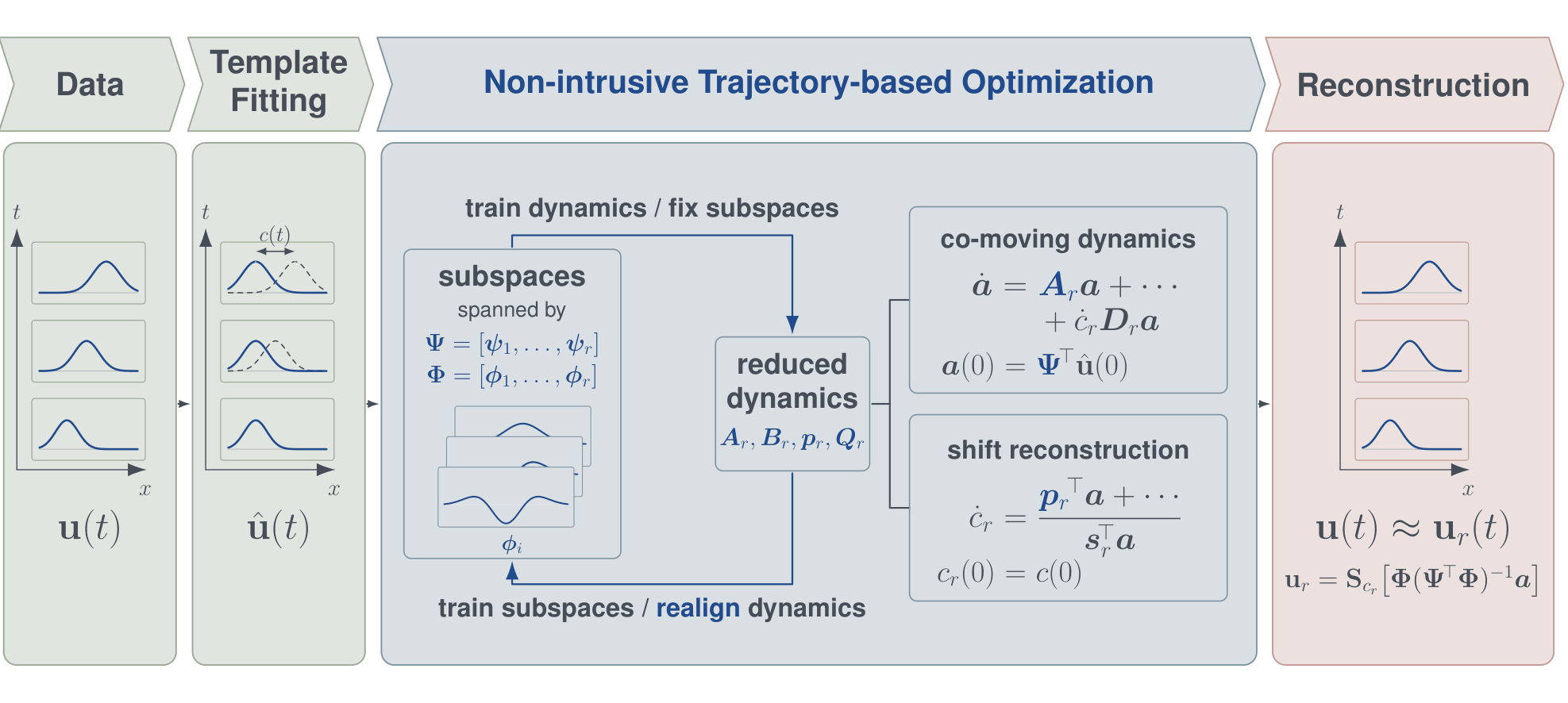
Pipeline of the S-R NiTROM method: snapshot data, template fitting to extract the shift, non-intrusive trajectory-based optimization that alternates between training the reduced dynamics with the subspaces fixed and training the subspaces with the dynamics realigned, then reconstruction of the full field.

We develop data-driven reduced-order models of partial differential equations with shift symmetry (also called shift equivariance). Such systems typically admit traveling solutions, which require many basis functions in a fixed reference frame. We instead represent the solution in a traveling reference frame, thereby obtaining a more compact representation. Existing methods such as operator inference then fit the reduced model directly from data, without knowledge of the full-order dynamics.

We are now developing a joint optimization that learns the projection subspaces and the symmetry-reduced dynamics together.

  • Symmetry-reduced model reduction of shift-equivariant systems via operator inference
    Yu Shuai and Clarence W. Rowley
    Advances in Computational MathematicsUnder revision
    arXiv:2507.18780, 2025.
    BibTeX
    @misc{shuai2025symmetryreduced,
      title = {Symmetry-reduced model reduction of shift-equivariant systems via operator inference},
      author = {Shuai, Yu and Rowley, Clarence W.},
      year = {2025},
      eprint = {2507.18780},
      archivePrefix = {arXiv},
      primaryClass = {math.NA},
      url = {https://arxiv.org/abs/2507.18780}
    }
Detecting Lagrangian coherent structures from sparse data

We are investigating flow reconstruction and Lagrangian coherent-structure analysis from sparse tracer measurements in the atmospheric surface layer, with attention to the limitations imposed by finite observations.

Sparse observations · flow reconstruction · Lagrangian analysis · no paper yet

Structured input–output analysis of wall-bounded shear flows

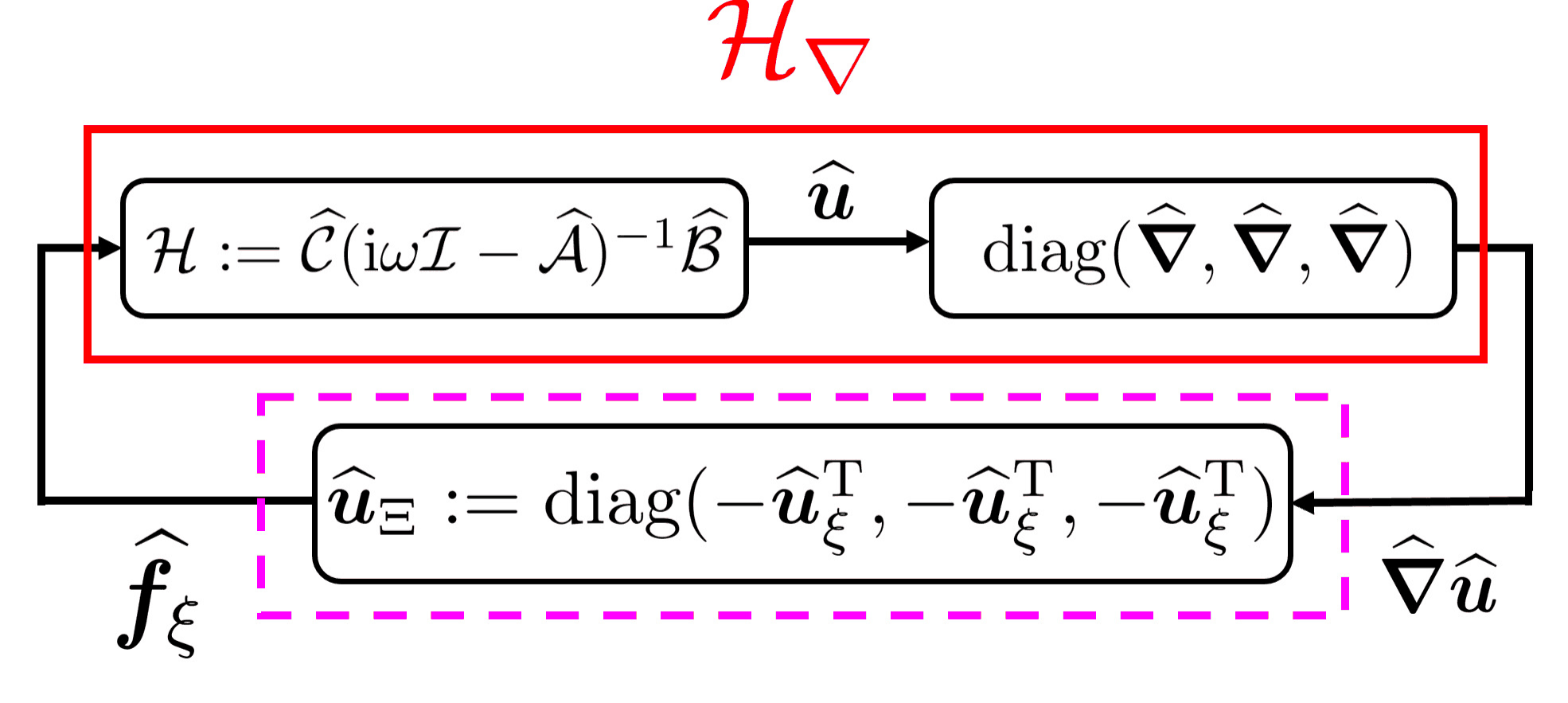
Block diagram of the structured input-output interconnection: the linear dynamics block H feeding a gradient block, closed by a structured feedback block, with the outer loop labelled H-nabla.

We studied the amplification and characteristic scales of oblique laminar–turbulent patterns in plane Couette–Poiseuille flow using structured input–output analysis.

Teaching

MAE 305: Mathematics in Engineering I

Assistant in Instruction.

MAE 222: Mechanics of Fluids

Assistant in Instruction.

MAE 305: Mathematics in Engineering I

Assistant in Instruction.

MAE 553: Turbulent Flow

Assistant in Instruction.

MAE 433: Automatic Control Systems

Assistant in Instruction.

Software

SROpInf

A Python package for symmetry-reduced operator inference of shift-equivariant systems.

Talks and Academic Activities

79th APS Division of Fluid Dynamics Meeting, Orlando, FL, USA, November 22–24, 2026. Scheduled

Type: Oral presentation

Title: Inferring Lagrangian Coherent Structures in the Atmospheric Surface Layer from Sparse Particle Measurements

SIAM Conference on Mathematics of Data Science (MDS26), Salt Lake City, UT, USA, November 16–20, 2026. Scheduled

Type: Minisymposium co-organizer (with Clarence W. Rowley) and oral presentation

Title: Non-Intrusive Optimization of Reduced-Order Models for Shift-Equivariant Systems based on Symmetry Reduction (minisymposium title: Data-Driven Nonlinear Reduced-Order Models for Transport-Dominated Systems)

78th APS Division of Fluid Dynamics Meeting, Houston, TX, USA, November 23–25, 2025.

Type: Oral presentation

Title: Non-Intrusive Model Reduction of Shift-Equivariant Systems via Data-Driven Projection and Symmetry-Reduced Dynamics

SIAM Conference on Applications of Dynamical Systems, Denver, CO, USA, May 11–15, 2025.

Type: Minisymposium co-organizer (with Clarence W. Rowley) and oral presentation

Title: Reduced-Order Modeling of Shift-Equivariant Systems Using Operator Inference (minisymposium title: Reduced-Order Modeling of Fluid Flow with Coherent Structures)

77th APS Division of Fluid Dynamics Meeting, Salt Lake City, UT, USA, November 24–26, 2024.

Type: Oral presentation

Title: Neural Network-Based Closure Model of the Ensemble-Averaging Dynamics of Turbulent Puffs in Transitional Pipe Flow

75th APS Division of Fluid Dynamics Meeting, Indianapolis, IN, USA, November 20–22, 2022.

Type: Oral presentation

Title: Structured Input-Output Analysis of Oblique Laminar-Turbulent Flow Patterns in Transitional Plane Couette-Poiseuille Flow

Honors and Awards

Guggenheim Second Year Fellowship, Princeton University

Award for Excellent Undergraduate Research Program, Peking University

Huatai Financial Technology Scholarship, Peking University

Boeing Scholarship, Peking University

Skills

Programming
Python (NumPy, SciPy, JAX, PyTorch), MATLAB, Fortran, C++
CFD libraries
Dedalus, Channelflow 2.0, Openpipeflow
High-performance computing
MPI, Slurm

Curriculum Vitae

Two pages, covering publications, talks, teaching and software. For anything not on it, please write to yu_shuai@princeton.edu.

View CV (PDF, 2 pages)